
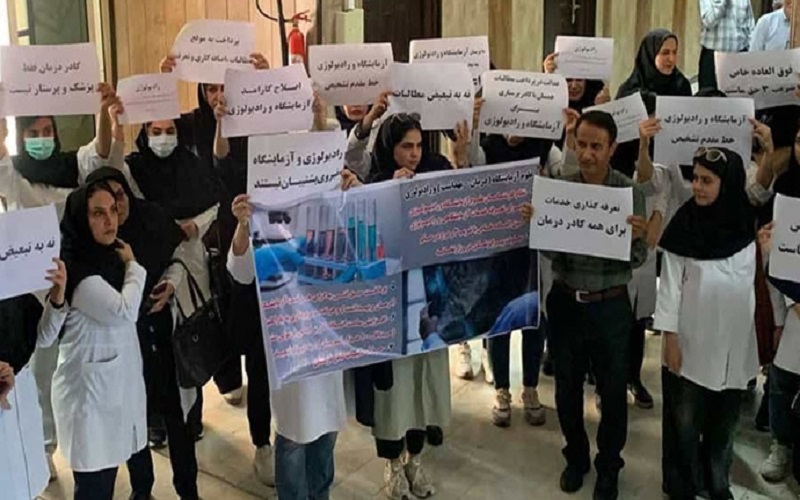
In recent years, Iran has witnessed an unprecedented wave of resignations and emigrations among its healthcare professionals, including doctors and nurses. The underlying reasons point to a range of structural, economic, and political issues that have made the country’s healthcare system increasingly unstable and unsustainable.
The Crisis in Iran’s Healthcare Sector
Low wages, a severe lack of job security, and inadequate social security and pension systems are among the main problems plaguing Iran’s medical workforce. In addition, Iran’s security and political institutions often interfere in the professional activities of doctors and nurses, creating a hostile work environment that undermines their autonomy and expertise. This atmosphere has pushed many of Iran’s dedicated healthcare professionals to either leave the country or, at the very least, step back from active service.
As reported by Abdolhasan Mostafavi, a member of Iran’s parliament, the nation currently faces a shortage of 12,000 doctors, which has led to the closure of numerous clinics in various cities. This shortage, which has been building up over four decades, raises a critical question: why are so many Iranian doctors and nurses leaving, and what are they seeking elsewhere?
Migration Driven by Economic Disparities
The Secretary General of the House of Nurses recently highlighted the financial challenges faced by healthcare professionals in Iran. Nurses often experience extended payment delays, sometimes up to eight months, and receive only around 140,000 tomans (approximately $2) per 7-hour shift. Ali Gachkooban, head of the Ahvaz nursing system, adds that salaries for Iranian nurses abroad, in countries like Oman, are nearly ten times higher than those they receive at home, often accompanied by housing and other benefits.
Ahmad Nejatian, head of Iran’s nursing system organization, provided alarming statistics, stating that his office issues 2,000 professional certification requests each year for nurses planning to emigrate. Meanwhile, Mohammad Sharifi Moghadam estimates that around 50,000 nurses are currently staying home, while Abbaszadeh from the Ministry of Health confirms a “massive migration” of nurses. Within the past year alone, 1,500 newly hired nurses have left, and approximately 500 others have emigrated.
These departures have created a critical shortage in Iran’s hospitals. While international standards recommend at least 1.8 nurses per hospital bed, Iran’s current ratio has fallen to 0.9, meaning less than one nurse per hospital bed.
Official Denial and Systemic Inaction
Despite these statistics, Iranian authorities have been reluctant to acknowledge the extent of the crisis. Commander Hossein Salami of the Islamic Revolutionary Guard Corps (IRGC) recently claimed that reports of mass healthcare migration are exaggerated, attributing them to “lies, psychological warfare, and negative propaganda” by foreign adversaries. However, numerous reports from health ministry officials, parliament members, hospital administrators, and union activists have all refuted this assertion, repeatedly confirming the severity of the situation.
Ahmad Nejatian recently reiterated these statistics in an interview, noting that each year, a number of nurses equivalent to the staff of two major hospitals leave the system. Meanwhile, government actions to address these shortages remain minimal, with no significant policy changes or efforts to retain healthcare staff.
Instead of addressing the grievances raised by doctors and nurses, the Iranian regime has taken a punitive approach. Mohammad Sharifi Moghadam, Secretary General of the House of Nurses, reported that, following sit-ins and protest rallies, security forces have filed cases against protest participants, leading to arrests and increased suppression.
The Broader Implications for Iran’s Society
Iran’s failure to retain its medical professionals raises profound concerns about the future of its healthcare system and the well-being of its citizens. As the nation’s most skilled healthcare workers either leave the country or disengage from public service, Iran faces not only a loss of expertise but also an ongoing “brain drain” of the professionals needed to address its domestic challenges.
The underlying question that many Iranians are asking is: Why are the nation’s best doctors and nurses leaving or struggling to make ends meet within the system? Why are salaries for these essential workers neglected, while massive resources flow toward military spending and other state priorities? The lack of decisive action to retain healthcare workers signals a broader systemic issue, one that leaves healthcare and other essential sectors vulnerable.
The government’s failure to address this critical healthcare crisis threatens the future of healthcare in Iran. As long as the regime continues to prioritize control over the welfare of its people, the exodus of doctors and nurses will likely continue, exacerbating an already severe crisis in public health and undermining Iran’s ability to care for its citizens.